Psychedelic science and therapies͏‌ ͏‌ ͏‌ ͏‌ ͏‌ ͏‌ ͏‌ ͏‌ ͏‌ ͏‌ ͏‌ ͏‌ ͏‌ ͏‌ ͏‌ ͏‌ ͏‌ ͏‌ ͏‌ ͏‌ ͏‌ ͏‌ ͏‌ ͏‌ ͏‌ ͏‌ ͏‌ ͏‌ ͏‌ ͏‌ ͏‌ ͏‌ ͏‌ ͏‌ ͏‌ ͏‌ ͏‌ ͏‌ ͏‌ ͏‌ ͏‌ ͏‌ ͏‌ ͏‌ ͏‌ ͏‌ ͏‌ ͏‌ ͏‌ ͏‌ ͏‌ ͏‌ ͏‌ ͏‌ ͏‌ ͏‌ ͏‌ ͏‌ ͏‌ ͏‌ ͏‌ ͏‌ ͏‌ ͏‌ ͏‌ ͏‌ ͏‌ ͏‌ ͏‌ ͏‌ ͏‌ ͏‌ ͏‌ ͏‌ ͏‌ ͏‌ ͏‌ ͏‌ ͏‌ ͏‌ ͏‌ ͏‌ ͏‌ ͏‌ ͏‌ ͏‌ ͏‌ ͏‌ ͏‌ ͏‌ ͏‌ ͏‌ ͏‌ ͏‌ ͏‌ ͏‌ ͏‌ ͏‌ ͏‌ ͏‌ ͏‌ ͏‌ ͏‌ ͏‌ ͏‌ ͏‌ ͏‌ ͏‌ ͏‌ ͏‌ ͏‌ ͏‌ ͏‌ ͏‌ ͏‌ ͏‌ ͏‌ ͏‌ ͏‌ ͏‌ ͏‌ ͏‌ ͏‌ ͏‌ ͏‌ ͏‌ ͏‌ ͏‌ ͏‌ ͏‌ ͏‌ ͏‌ ͏‌ ͏‌ ͏‌ ͏‌ ͏‌ ͏‌ ͏‌ ͏‌ ͏‌ ͏‌ ͏‌ ͏‌ ͏‌ ͏‌ ͏‌ ͏‌ ͏‌ ͏‌ ͏‌ ͏‌ ͏‌ ͏‌ ͏‌ ͏‌ ͏‌ ͏‌ ͏‌ ͏‌ ͏‌ ͏‌ ͏‌ ͏‌ ͏‌ ͏‌ ͏‌ ͏‌ ͏‌ ͏‌ ͏‌ ͏‌ ͏‌ ͏‌ ͏‌ ͏‌ ͏‌ ͏‌ ͏‌ ͏‌ ͏‌ ͏‌ ͏‌ ͏‌ ͏‌ ͏‌ ͏‌ ͏‌ ͏‌ ͏‌ ͏‌ ͏‌ ͏‌ ͏‌ ͏‌ ͏‌ ͏‌ ͏‌ ͏‌ ͏‌ ͏‌ ͏‌ ͏‌ ͏‌ ͏‌ ͏‌ ͏‌ ͏‌ ͏‌ ͏‌ ͏‌ ͏‌ ͏‌ ͏‌ ͏‌ ͏‌ ͏‌ ͏‌ ͏‌ ͏‌ ͏‌ ͏‌ ͏‌ ͏‌ ͏‌ ͏‌ ͏‌ ͏‌ ͏‌ ͏‌ ͏‌ ͏‌ ͏‌ ͏‌ ͏‌ ͏‌ ͏‌ ͏‌ ͏‌ ͏‌ ͏‌ ͏‌ ͏‌ ͏‌ ͏‌ ͏‌ ͏‌ ͏‌ ͏‌ ͏‌ ͏‌ ͏‌ ͏‌ ͏‌ ͏‌ 

New research is exploring the potential of psychedelic therapies in treating mental health conditions such as depression and eating disorders. This news flash provides summaries of three recent studies from reputable medical journals - JAMA, Nature Medicine and NEJM - offering a look into emerging treatment options.

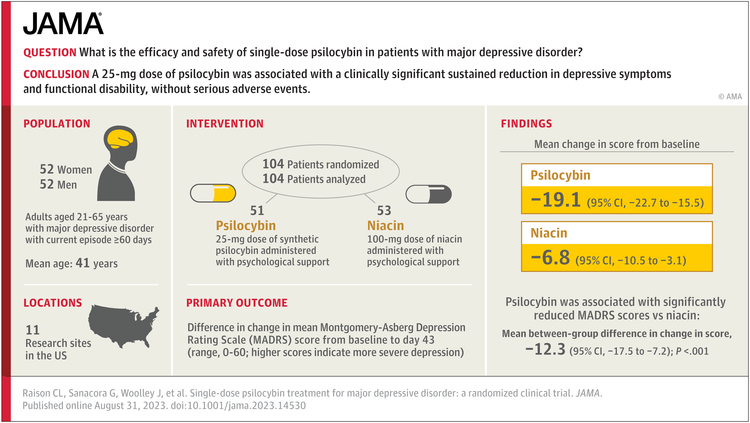
Single-dose psilocybin treatment for major depressive disorder: a randomized clinical trial

A recent study published in the Journal of the American Medical Association (JAMA) suggests that psilocybin holds promise as a treatment for major depressive disorder.

The trial involved 104 adults and was conducted across 11 research sites in the U.S. from December 2019 to June 2022.

The study revealed a rapid and sustained antidepressant effect. Notably, most of this effect was evident within a week following the dose, and it remained stable for the subsequent five weeks.

Importantly, the study reported no serious treatment-emergent adverse events.

For further details, you can access the JAMA study and the associated editorial. We particularly recommend the JAMA podcast featuring the study authors. The podcast not only delves into the trial design but also explores their unique therapeutic possibilities. It emphasizes the treatment's trans-diagnostic approach, addressing not just specific symptoms but also broader emotional and existential issues such as despair, distress, and feelings of shame. The podcast highlights how psychedelics like psilocybin can foster openness and facilitate engagement with often-avoided and suppressed emotions, making change a real possibility.

Psilocybin therapy shows promise for females with Anorexia Nervosa: a study in Nature Medicine

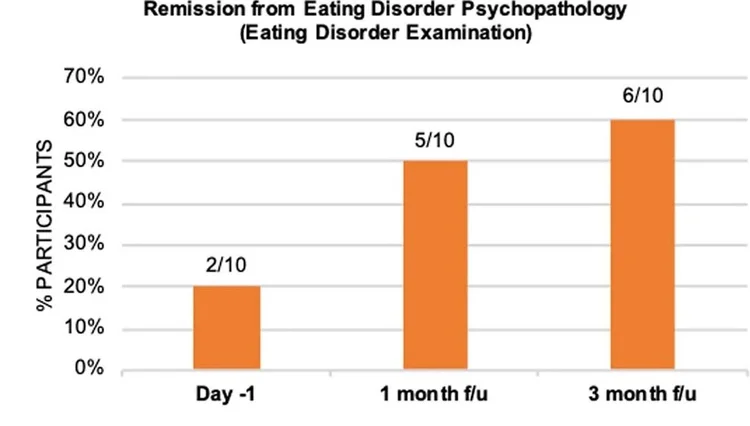
A recent study published in Nature Medicine has shed light on the potential of psilocybin therapy as a treatment for Anorexia Nervosa (AN) in females. Conducted between April and December 2021, the trial enrolled 10 female adults and aimed to assess the safety, tolerability, and exploratory efficacy of a single 25-mg dose of psilocybin in conjunction with psychological support.

Key Findings:

  • The therapy was found to be safe and well-tolerated, with no serious adverse events reported.

  • Participants experienced variable but promising effects on eating disorder psychopathology.

  • Most participants found the psilocybin experience meaningful and impactful, suggesting a positive life impact.

The study emphasizes the need for larger, controlled trials to confirm these preliminary findings. However, the results are promising and could pave the way for innovative treatments for this notoriously difficult-to-treat disorder.

You can access the full Nature Medicine study here.

Ketamine vs. ECT: A comparative study for treatment-resistant major depression published in NEJM

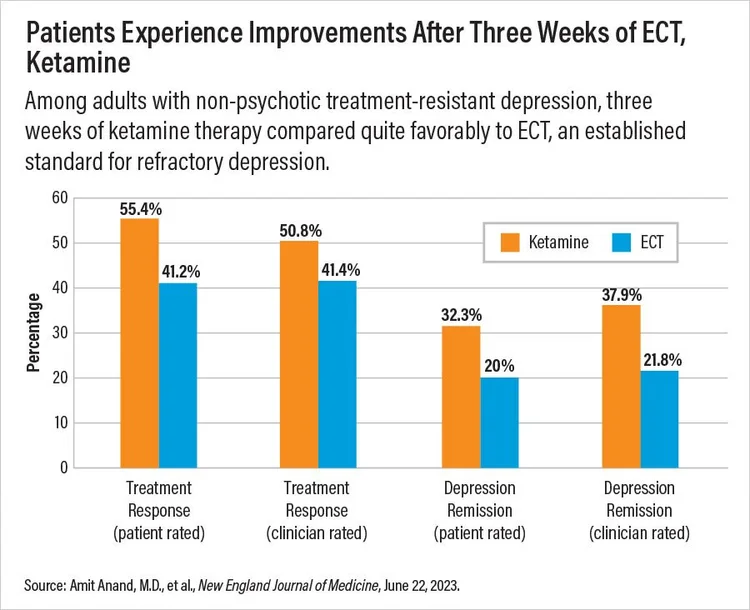
A study published in the New England Journal of Medicine has compared the effectiveness of ketamine and Electroconvulsive Therapy (ECT) for treating nonpsychotic treatment-resistant major depression. The study involved 403 patients and was conducted across five clinical sites.

Key Findings:

  • Ketamine proved to be noninferior to ECT, with 55.4% of patients in the ketamine group showing a response compared to 41.2% in the ECT group.

  • ECT was associated with a decrease in memory recall, while ketamine was linked to dissociative experiences.

  • Both treatments showed variable effects on patient-reported quality of life.

The study emphasizes the potential of ketamine as an alternative to ECT for treating this form of depression, especially considering the fewer cognitive side effects.

You can access the full NEJM study here.

------------------------------

Much more research is on the horizon, including the soon-to-be-published second Phase 3 study focusing on MDMA-assisted therapy for PTSD. We will keep you updated on these important developments.

 ✉️ CONTACT PAREA 
LAUNCH

www.parea.eu

PAREA , Brussels , Belgium

Unsubscribe