

Reflections from the World Ayahuasca Forum 2026
By Cecilie Byholt Endresen, Organisational and Clinical Psychologist, President of the Norwegian Association for Psychedelic Science
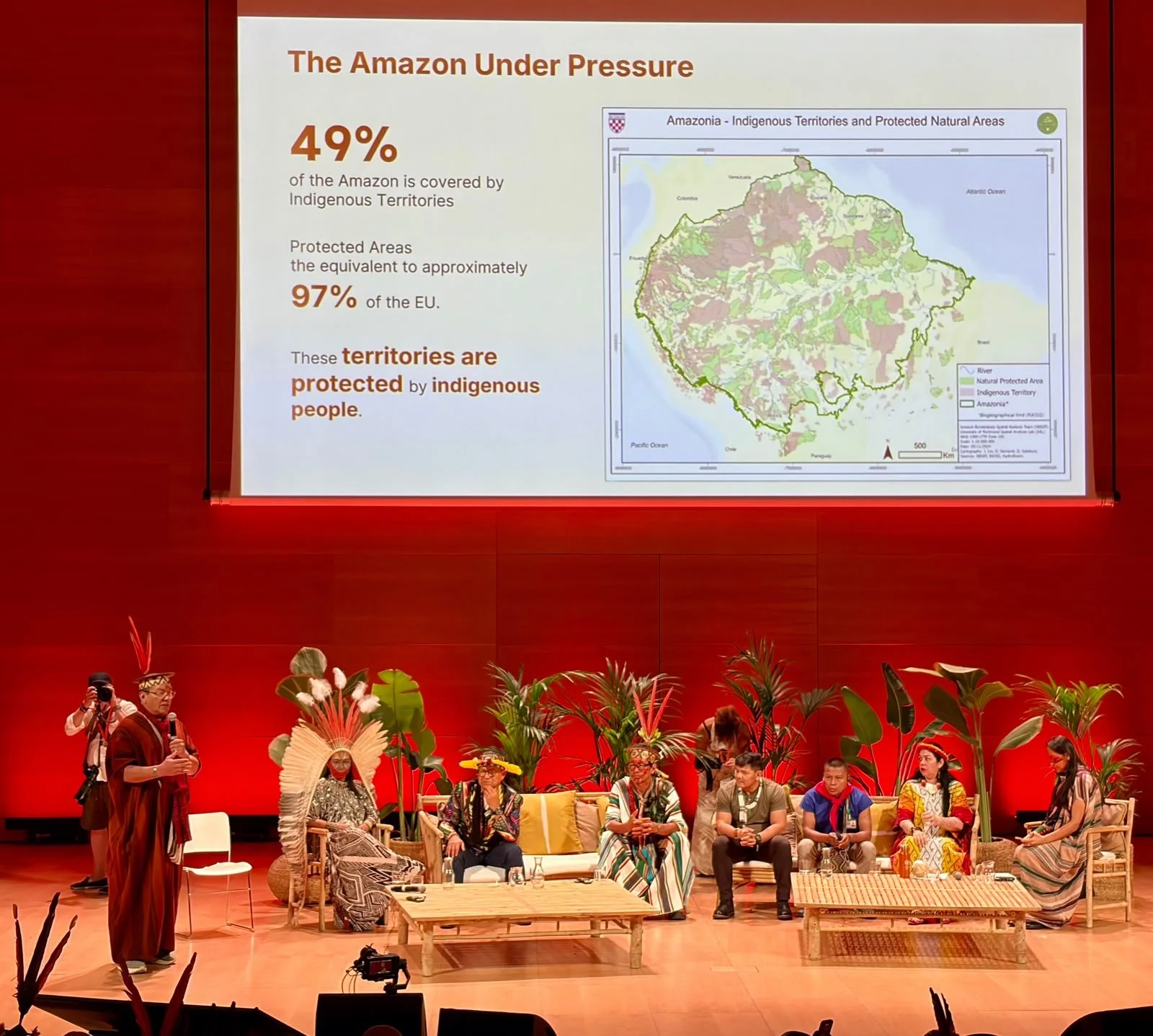
In September 2026, more than 1,700 people gathered in Girona, Spain, for the World Ayahuasca Forum (WAF). Among them were over 100 Indigenous leaders from more than 30 nations, alongside researchers, clinicians, policymakers and activists. Organised by ICEERS, the Yorenka Tasorentsi Institute and Instituto Cultural Nixiwaka, the forum was shaped together with Indigenous leaders, who helped decide its programme and outcomes. Indigenous voices were at the centre of its conversations about the globalisation of ayahuasca.
For those of us working towards the responsible integration of psychedelic-assisted therapies into European healthcare, Girona raised questions that extend well beyond clinical efficacy, regulatory approval and patient access.
Ayahuasca may not become central to publicly funded psychedelic healthcare in Europe. Yet the questions raised at WAF concern the wider direction of our field: how we understand these substances, how we regulate them, and what responsibilities follow from their growing scientific and commercial importance.

Daiara Tukano
Beyond Compounds: Why Context Matters
One of the central messages from Indigenous representatives challenged the very language through which Western societies understand psychedelics.
For many Indigenous communities, ayahuasca is neither a drug nor simply a medicine in the biomedical sense. It exists within living relationships between people, plants, territories, ancestors and spiritual worlds. This relational understanding contrasts with the predominantly reductionist and individual-centred approaches of Western biomedicine, where substances are studied through their chemical properties, biological mechanisms and effects on individual patients.
As one statement from the forum captured it:
“They’re looking for compounds, not custodians.”
Western science has generated invaluable knowledge by isolating active compounds, investigating mechanisms and testing clinical efficacy. Yet isolation has its limits, even at the level of chemistry. Early, mainly preclinical research suggests that the effects of psilocybin mushrooms cannot be reduced to a single molecule, as other compounds in the mushroom may contribute to what has been described as an entourage effect. The discussions in Girona challenged us to go further and consider what may be lost when plants and practices are separated from the cultural, ecological and social contexts in which they belong.
This is not only a philosophical or ethical question. It also resonates with psychedelic clinical research.
Set and setting have long been recognised as central to psychedelic effects and are receiving growing attention in clinical trials. Researchers have argued that the compound alone cannot fully explain the psychedelic experience or its therapeutic outcomes: the psychological, relational and environmental context matters. Studies have found associations between the quality of the therapeutic relationship, the nature of the psychedelic experience and subsequent clinical improvement. Although important questions remain about the mechanisms and relative contributions of these factors, the implications are significant.
Recognising the importance of context in clinical research does not mean that Indigenous understandings and biomedical perspectives are interchangeable. They represent different knowledge traditions, with different methods, purposes and ways of understanding the world. Yet acknowledging these differences creates opportunities for dialogue in which both perspectives can inform and challenge one another.
As one message from Girona reminded us:
“Dialogue is not assimilation.”
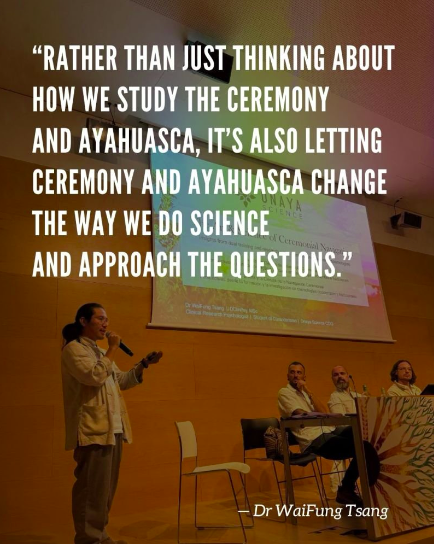
Dr. WaiFung Tsang from Onaya
Regulation Is Never Culturally Neutral
The implications of Girona also extend to drug policy.
The comparison with coca offered a concrete warning. For thousands of years, coca leaves have held cultural, medicinal and spiritual significance for Indigenous communities in the Andes. Yet the 1961 UN Single Convention on Narcotic Drugs placed coca leaves under strict international control and required traditional coca-leaf chewing to be phased out.
The question posed in Girona was direct:
“Will you do to ayahuasca what you did to coca?”
This is not merely a historical concern. In December 2025, following a comprehensive scientific review, the World Health Organization recommended maintaining coca leaf in Schedule I of the 1961 Convention. The review acknowledged that traditional coca chewing and coca tea consumption do not appear to pose significant public health risks. Nevertheless, the recommendation was to retain international controls, primarily because coca leaves can be converted into cocaine and because of concerns about the expanding illicit cocaine market.
At its session in March 2026, the UN Commission on Narcotic Drugs confirmed the existing control status. Traditional uses permitted under national legislation remain unaffected, but internationally, the leaf continues to be classified alongside cocaine.
The comparison does not imply that coca and ayahuasca are pharmacologically or legally equivalent. Rather, it illustrates how regulatory decisions can have consequences far beyond their intended public health objectives.
For European policymakers, this raises an important question: How can we develop evidence-based regulatory frameworks that protect public health while also recognising cultural practices, Indigenous rights and different ways of understanding these substances?
Scientific evidence is essential to responsible regulation. But regulation also involves decisions about which risks, values and interests are prioritised, and whose perspectives are represented.
Rethinking Responsibility in an Interconnected World
Perhaps the most profound challenge from Girona concerned our understanding of responsibility across generations.
Many Indigenous perspectives emphasise that decisions should not be guided solely by immediate interests or benefits. We inherit knowledge, relationships and responsibilities from those who came before us, and our actions shape the conditions of life for those who follow.
These responsibilities extend beyond humanity.
Plants, animals, rivers, forests and entire ecosystems are part of the living world to which we are connected and accountable. This understanding of kinship between humans and the other-than-human world challenges the human-centred and relatively short-term perspectives that often characterise modern healthcare, research and policymaking.
A similar shift is emerging within Western medicine. A recent consensus statement on Ecological Medicine (Makhinson et al., 2026) proposes a relational understanding of health, recognising the interdependence between humans, other species and the natural environment.
Yet the perspectives shared in Girona invite us to go further.
It is not simply a question of how nature can contribute to human health, but how our healthcare systems, research practices and policies can contribute to the wellbeing of the wider living world.
What would responsible psychedelic innovation look like if we considered its consequences not only for today's patients and healthcare systems, but also for the generations that will inherit the world we leave behind — human and other-than-human alike?
For us in the Nordic region, these questions are particularly meaningful. The manifesto of the Nordic Psychedelic Network commits us to sustainable development grounded in values such as ecological responsibility, Indigenous wisdom, youth perspectives and social equity, alongside ethical and evidence-based development of the field. From the perspective of the Norwegian Association for Psychedelic Science, these principles should inform how psychedelic research, clinical practice and policy develop, both within our region and across Europe.
What Kind of Future Are We Building?
At a time of ecological destruction, biodiversity loss and growing social inequalities, the messages from Girona extend far beyond the future of psychedelic medicine.
The so-called psychedelic renaissance is, after all, largely a Western renaissance. Many of the knowledge traditions now attracting scientific interest have been sustained across generations, often despite colonisation and marginalisation.
Europe has an opportunity to develop psychedelic healthcare that is scientifically rigorous, safe and accessible, while also grounded in respect, reciprocity and long-term responsibility.
The challenge is not simply how we bring psychedelics into our healthcare systems, but which values and relationships we choose to build into those systems. As another message from Girona reminded us:
“We walk at the pace of trust.”
Perhaps progress should not only be measured by how quickly we move forward, but by the responsibilities we honour and the world we leave behind.
Read the full report in the Norwegian Association for Psychedelic Science’s newsletter here.
Selected references
Carhart-Harris, R. L., et al. (2018). Psychedelics and the essential importance of context. Journal of Psychopharmacology, 32(7), 725–731. https://doi.org/10.1177/0269881118754710
Estric, C., Duron, T., Kabani, S., & Lopez-Castroman, J. (2025). Set and setting of psychedelics for therapeutic use in psychiatry: A systematic review. Journal of Psychopharmacology, 39(9), 910–929. https://doi.org/10.1177/02698811251338214
Makhinson, M., et al. (2026). A Consensus Statement for Ecological Medicine: Moving Toward Connection-Based Medicine. EcoHealth, 23, 153–166. https://doi.org/10.1007/s10393-025-01757-3
Murphy, R., et al. (2022). Therapeutic Alliance and Rapport Modulate Responses to Psilocybin Assisted Therapy for Depression. Frontiers in Pharmacology, 12, 788155. https://doi.org/10.3389/fphar.2021.788155
Nordic Psychedelic Network (2025). Manifesto for the Nordic Psychedelic Network Initiative. Signed in Reykjavik, 26 February 2025. See: Endresen, C. B. (2025). New Era for Psychedelic Science in the Nordic Region. PAREA. https://parea.eu/guest-posts/psychedelic-science-in-the-nordic-region
World Health Organization (2025, 10 December). WHO Expert Committee concludes critical review of coca leaf, recommends maintaining current controls. https://www.who.int/news/item/10-12-2025-who-expert-committee-concludes-critical-review-of-coca-leaf--recommends-maintaining-current-controls
World Health Organization (2026, 23 April). UN drug policy body acts on WHO recommendations to control new psychoactive substances and considers coca leaf review. https://www.who.int/news/item/23-04-2026-un-drug-policy-body-acts-on-who-recommendations-to-control-new-psychoactive-substances-and-considers-coca-leaf-review
