On Information Governance and Transcultural Knowledge Translation: Contributions from the Global South to the Coherence of the Psychedelic Renaissance
Diego Giacoman. Ser Ajayu Founder (Bolivia)
The psychedelic renaissance is advancing in Europe with urgent debates on regulation, equitable access, ethics and implementation frameworks. For these processes to be inclusive, sustainable and legitimate, it seems necessary to build knowledge frameworks that involve at least two key aspects: robust information governance and effective transcultural knowledge translation. These tools could help preserve the multidimensionality in the analysis of the enteogenic experience — its character as a Technology of the Sacred — and address the concrete questions facing policymakers around the world today.
Governance and Epistemic Justice
Information governance can be built as a collective exercise of epistemic sovereignty and justice¹. It is the deliberate process through which a plurality of actors decides what knowledge is legitimate, how it is validated, preserved and disseminated in the field of enteogenic substances. When constructed collectively and on equal terms, this governance transforms the space of truth into a common good, preventing the appropriation of knowledge and extractivism.
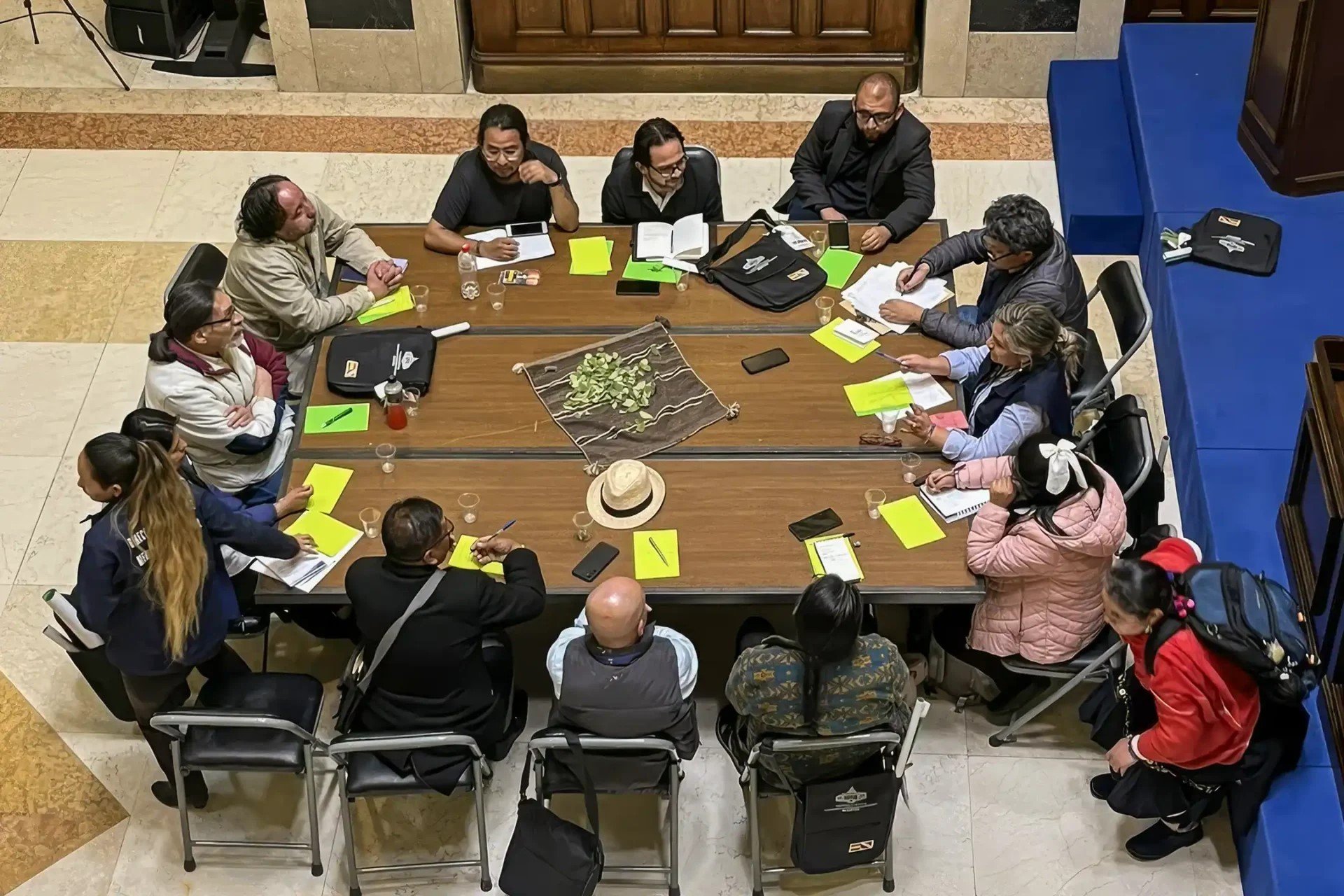
In such a scenario, participants can act on equal footing: keepers of ancestral traditions, scientific researchers, people with lived experience (especially from disadvantaged populations), philosophers, regulators and civil society. The approach is transcultural and relational: continuous deliberation in which every voice is heard in its own epistemic logic and all accept being mutually transformed.
Building this governance has direct implications for Europe. As the EU advances regulatory pathways for psychedelic-assisted therapies, standardized protocols and clinical guidelines, inclusive governance can help resolve concrete issues, among which the following stand out: how to incorporate ancestral knowledge without extractivism, how to guarantee equitable access for vulnerable communities, and how to design ethical frameworks that prevent industrial capture.
Transcultural Translation
For this article, transcultural translation² is understood as the process through which knowledges from different historical matrices — not reduced to an indigenous-scientific dichotomy — meet, mutually transform one another and generate practical solutions. It is important to recognise that ancestral wisdoms span a broad spectrum, from Indigenous American traditions to Vedic,
Buddhist and Taoist currents that have explored altered states of consciousness for millennia.
In this crossing, science and spirituality can open symmetrically. Science can remain open to the unknown beyond the repetition of rules and principles. Spirituality, for its part, can value technical development to expand its historical impact on the well-being of future societies. This double opening requires the creation of a common transcultural language: a conceptual framework of consensus that facilitates genuine deliberation and avoids unilateral reductions.
A key point in this approach is that, for regulators to truly understand the complexity of the topic, it is essential that they experience the enteogenic experience themselves. Only through direct personal encounter can one grasp the depth and multidimensional nature of what we are discussing and fully appreciate the critical importance of knowledge translation. It is worth highlighting that the process of legalizing ayahuasca in Brazil culminated in a CONFEN working group between 1987 and 1988, whose members investigated its use in the Amazon and even consumed the beverage during the rituals.
In summary, building information governance and transcultural knowledge translation can project the psychedelic renaissance toward a coherent future: a movement that honours the historical plurality of humanity and provides practical, shared solutions to modern challenges in mental health, access and regulation.
Those who today design regulatory frameworks in Europe face a key responsibility. Integrating these perspectives is not a theoretical exercise: it is the condition for regulatory frameworks to be legitimate, sustainable and resilient in the face of the risks of knowledge appropriation, lack of access for vulnerable populations, bias and industrial capture.

References
¹ Santos, B. de S. (2014). Epistemologies of the South: Justice against epistemicide. Paradigm Publishers.
² Ortiz, F. (1940/1995). Contrapunteo cubano del tabaco y el azúcar. Editorial de Ciencias Sociales.
³ Puente, Iker. Filosofía oriental y ciencias cognitivas: una introducción. Universidad Autónoma de Barcelona.
