

EU pharmaceutical legislation: agreement reached on major overhaul
EU institutions have reached agreement on the revision of pharmaceutical legislation, marking the first comprehensive update in over two decades. The direction is now set, although formal adoption will follow later in the process.
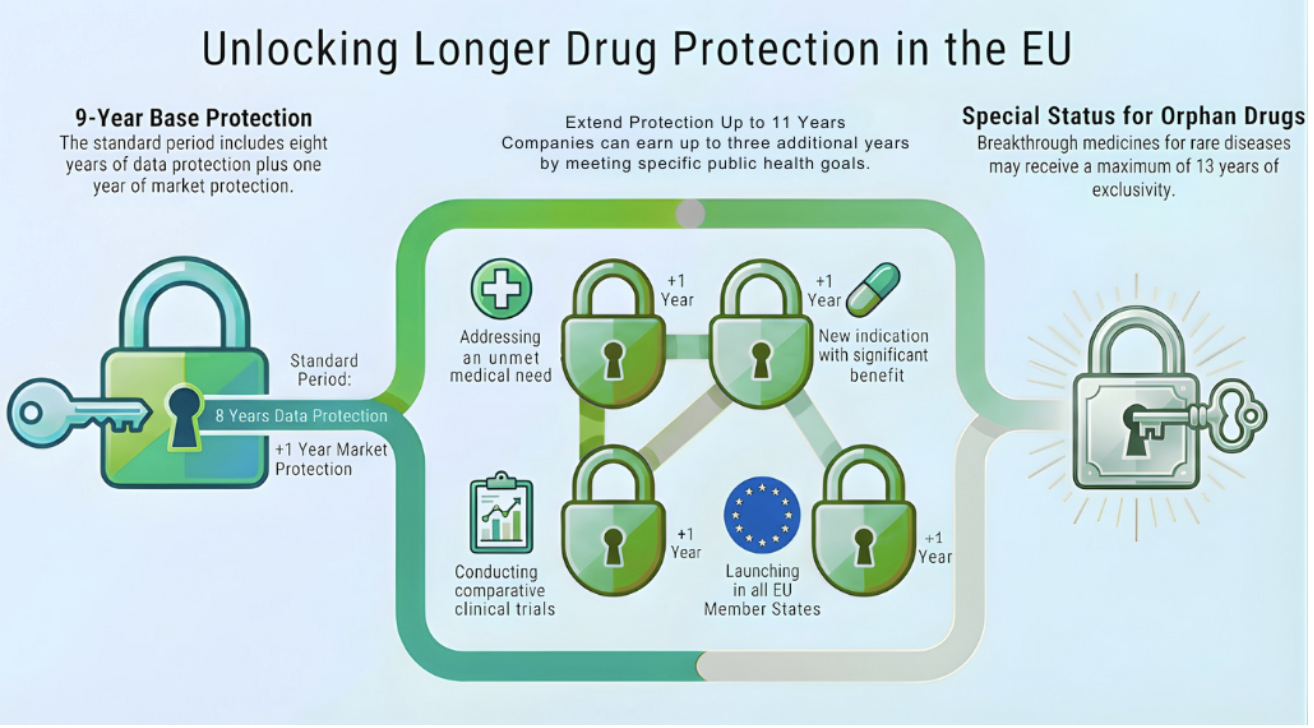
A central part of the deal concerns regulatory protection.
Regulatory data protection is maintained at 8 years, meaning generics and biosimilars cannot rely on the originator’s data during that period.
Market protection is set at 1 year, replacing the previous 2-year baseline.
Additional one-year extensions are possible for meeting criteria such as running clinical trials in Europe, conducting comparative studies, addressing unmet medical needs, or submitting first in Europe. The combined maximum protection is 11 years.
On access, the agreement addresses long-standing delays in smaller member states. Countries will be able to require companies to submit pricing and reimbursement dossiers within a defined timeframe or provide a clear roll-out plan. Failure to comply may result in the loss of market protection in that member state after three years.
A notable development is the introduction of regulatory sandboxes — structured, time-limited environments for controlled testing under regulatory oversight. PAREA has engaged with the Parliament and member states on this provision, as it could become an important tool for areas that have lacked sustained innovation, including mental health. We are now preparing concrete sandbox proposals linked to psychedelic therapies to explore practical application of this new mechanism.
Additional elements include changes to EMA processes — such as shortening scientific opinion timelines from 210 to 180 days — and more limited R&D transparency obligations. Publication in the Official Journal is expected in Q2 2026.
After two decades without a full revision, this agreement represents a shift in how Europe approaches pharmaceutical incentives, access, and experimentation. What matters now is implementation — especially how tools such as unmet-need criteria and sandboxes are applied. PAREA will continue advocating for mental health conditions to be recognised within this framework as the package moves forward.
European Commission policy officer Ferenc Marofka prepared a useful side-by-side comparison of EU pharmaceutical incentives with those in the United States and China. It can be viewed here.
