European Forum of National Psychedelic Societies
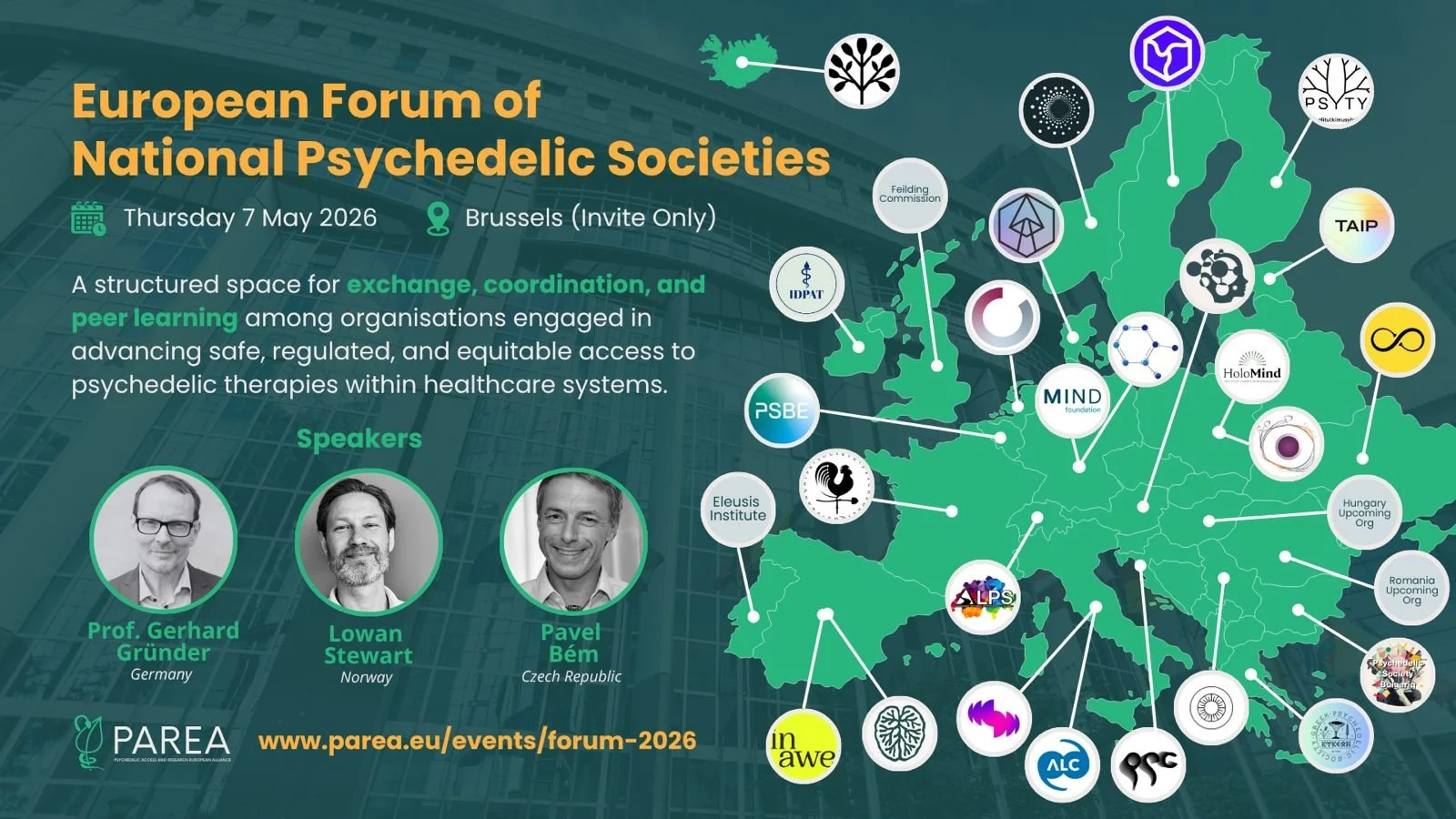
The European Forum of National Psychedelic Societies is a closed, invitation-only meeting convened by PAREA in Brussels, bringing together representatives of organisations from 25 countries working on psychedelic research, policy, and access across Europe.
The Forum aims to create a structured space for exchange, coordination, and peer learning among organisations engaged in advancing safe, regulated, and equitable access to psychedelic therapies within healthcare systems.
Focus of the meeting
The Forum will focus on two core dimensions.
The first is access. This includes early access pathways, compassionate use, rescheduling, and emerging regulatory developments across European countries.
The second is implementation and engagement. This includes advocacy strategies, working with policymakers and regulators, coalition-building, and strengthening national-level capacity to support future access.
The programme is designed to move beyond general discussions and focus on practical experience, lessons learned, and approaches that can be adapted across different national contexts.
Participation
This is a closed, invitation-only meeting bringing together a curated group of organisations aligned with PAREA’s focus on medical access through healthcare systems.
The Forum is not open for public registration.
Countries and organisations represented
The Forum brings together leaders representing organisations from 24 countries across Europe, reflecting a broad and diverse landscape of national initiatives.
Participating countries and organisations include:
Austria – Association for Psychedelic Science & Therapy Austria (APSTA)
Belgium – Psychedelic Society Belgium (PSBE)
Bulgaria – Psychedelic Society Bulgaria
Croatia – Psychedelic Research Society Croatia
Denmark – Danish Center for Psychedelic Education (CEPDA)
Estonia – Foundation for Therapeutic Advancement and Innovation with Psychedelics (SA TAIP)
Finland – Finnish Association for Psychedelic Research
France – French Psychedelic Society (Société Psychédélique Française / SPF)
Germany – German Society for Psychedelic Research and Therapy (DGPFT); MIND Foundation
Greece – Greek Psychedelic Society (Kykeon)
Hungary – Upcoming Hungarian organisation
Iceland – Icelandic Psychedelic Society - Hugvikandi
Ireland – Irish Doctors for Psychedelic Assisted Therapy (IDPAT)
Italy – Italian Society for Psychedelic Medicine (SIMEPSI); Luca Coscioni Association
Netherlands – OPEN Foundation
Norway – Norwegian Association for Psychedelic Science (NPV)
Poland – Polish Psychedelic Society; HoloMind Foundation
Portugal – Eleusis Institute
Romania – Upcoming Romanian organisation
Serbia – National Association for Psychedelic Research
Spain – inawe Foundation / Spanish Society for Psychedelic Medicine (SEMPSi)
Sweden – Swedish Network of Psychedelic Science
Switzerland – Awareness Lectures on Psychedelic Science (ALPS)
Ukraine – Ukrainian Psychedelic Research Association (UPRA)
United Kingdom – Feilding Commission
Guest speakers
The Forum will feature contributions from leading experts and practitioners who have been directly involved in advancing access and regulatory developments in Europe.
Prof. Gerhard Gründer (Germany)
Professor of Psychiatry and leading expert in neuropsychopharmacology, involved in advancing clinical research and compassionate use with psychedelic therapies in Germany.Lowan Stewart (Norway)
Clinician and key architect behind the nationwide reimbursement of ketamine treatment in Norway, with direct experience in implementing access within public healthcare systems.Pavel Bém (Czech Republic)
Physician and policy leader who has played a central role in recent rescheduling and psilocybin policy developments in the Czech Republic
Context
The Forum builds on PAREA’s ongoing work at the European level to support policy development, research, and access to psychedelic therapies, as well as its engagement with national organisations through the Community Supporters network.
It also lays the groundwork for longer-term collaboration, with the aim of strengthening coordination across countries and supporting the development of practical pathways to access in Europe.